


Choosing the right gates for period houses is crucial to preserving the architectural integrity of the property in question. Make a mistake here and even excellent gates will look out of place, ruining the entire appearance. Get it right and the boundaries will enhance the character of the place. Most people fail to achieve this due to missing subtleties which are essential in making the right choice.
We have seen many examples of beautifully restored Victorian terraces ruined with the choice of the wrong type of gates which scream "WRONG ERA!" at any potential buyer of the property. The other classic example includes gates featuring Art & Crafts style metalwork in Georgian townhouses. Such examples continue endlessly because people put their hard earned money into buying appropriate gates yet fail to understand what "appropriate" really means in their particular case.
Knowing architectural eras and their language allows for making an educated choice which saves time and money in the long run and is immediately detected by experienced estate agents during property viewings.
Georgian Era Gates (1714-1830)
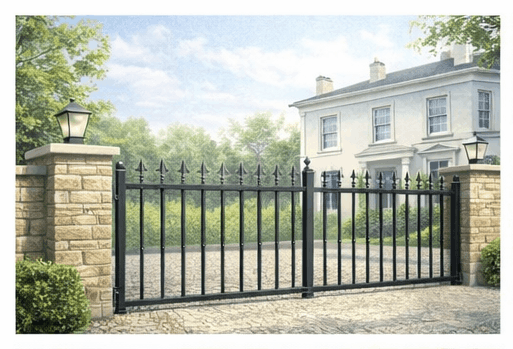
Georgian architecture relies on symmetry, proportions, and classical approach in general. It is logical that Georgian gates follow the same logic.
The dominant element in Georgian gate design is the vertical one. Simple bars positioned evenly provide the required visual rhythm. Decorations are kept minimalistic and are done in mathematical proportion. Any ornamentations are based on Greek key patterns, scroll patterns, and finials which refer to classical architecture.
The key element of Georgian design is restraint. Complex scrollwork, excessive ornamentations, and anything that disrupts the sense of proportion are not in keeping with this architectural period.
Our Classic and Regent collections are a perfect fit for the Georgian era.
Traditional colours of Georgian gates were black or very dark green. These were contrasting yet restrained options for the period in question.
Victorian Era Gates (1837-1901)
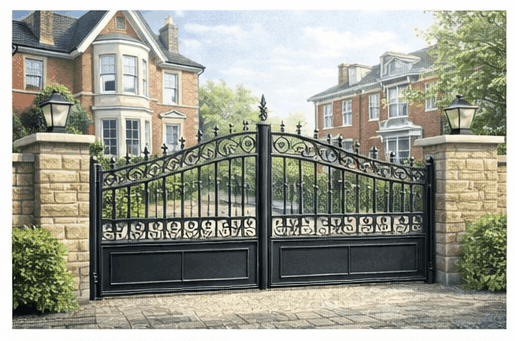
Unlike Georgian period, Victorian gates were ornamental. They were more decorative than those designed for the previous period.
Although vertical bars are used, they are provided with some decorative features like twists, variations of thickness, or alternations in bar profiles. Scrollwork’s became a prominent feature too, often including botanical, geometric or purely ornamental motifs. Finials got decorated with various ornaments such as spears, balls, Fleur de Lis and acorns.
While being more ornamental than Georgian gates, Victorian gates are systematic in their approach to the use of ornamentations. All ornaments and decorations are arranged in strict mathematical proportion.
There are differences between Early, Mid, and Late Victorian style gate designs. While early Victorian gates were more restrained in the use of decoration, mid-Victorian period gates included maximal amount of ornaments while Late Victorian style was moving towards Arts and Crafts movement.
Our Balmoral, Manor, and Warwick ranges reflect the spirit of this particular period.
Victorian gates offered more colour options in comparison with their Georgian counterparts. Black still remained a popular option. However, dark greens, browns and even burgundy colours became widely used too.
Edwardian Period Gates (1901-1910)
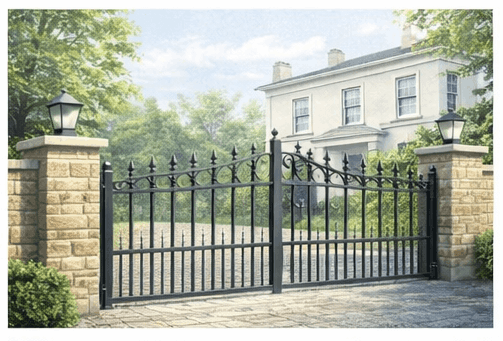
Although this era did not last long, Edwardian period is characterised by simplification of Victorian gates. At the same time, there was a move away from factory production towards handcraft.
Decorations are still used in gate design but they are far from being as elaborate as in the case of mid-Victorian period. Some decoration, however, is still necessary to distinguish this period from the former. Bars are provided with gentle twists or alternations in profile.
Influence of Arts & Crafts movement became more evident. It meant that there must be an indication of individual production in terms of design. It could be achieved via slightly irregular spacing, hand forged bars, or visible joinery.
Edwardian period is known to prefer lighter and more transparent gates in comparison with the previous period.
Our Saxon and Stirling ranges perfectly match this architectural period.
Arts and Crafts Movement (1880-1920)
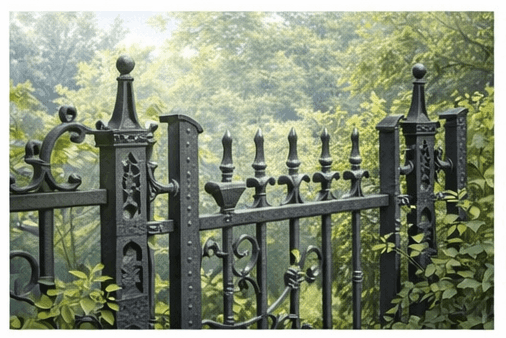
Although this movement occurred mostly during Victorian period, its principles influenced Edwardian period design. Therefore, properties with this kind of influence require gates reflecting these principles.
Individual crafting is a key element of Arts & Crafts movement. The idea is to make gates that would suggest individual craft work. Thus, some small deviations, hammer marks, or visible joinery can be used.
Designs should be inspired by nature. Thus, botanical motifs can be incorporated in gate design but in a stylised way. Medieval motifs including geometric designs were widely used too. It is possible to combine vertical and horizontal designs in order to achieve visual complexity.
Arts and Crafts preferred natural metals appearance or extremely dark finish of the iron. Dark grey, bronze, or black colour were popular among craftsmen of that time.
Matching this architectural movement requires not only knowing its basic elements but also understanding its philosophy.
Art Deco Period (1920-1939)
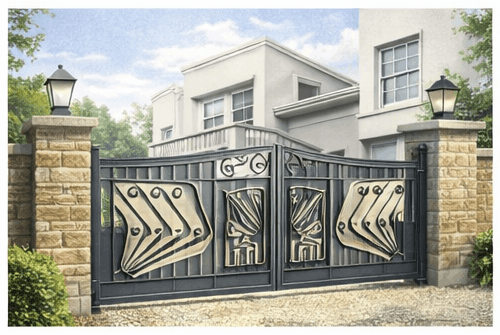
This period is known for its geometric proportions, precision, and modernist design. Properties that require matching Art Deco period must have similar gates.
First of all, the use of geometric patterns is characteristic of this period. Zigzag patterns, stepped forms, and sunburst designs prevail here. Curves are allowed but they are smooth unlike the ones of Victorian period. Geometrical composition and symmetry are key elements of Art Deco design.
It is also characteristic of this period to combine vertical bars and wider bars creating bold rhythm of the design.
Colour choices are either traditional painting or natural metal appearance including chrome and bronze colours. If painting is used, then black or metallic colours are used.
Common Matching Errors
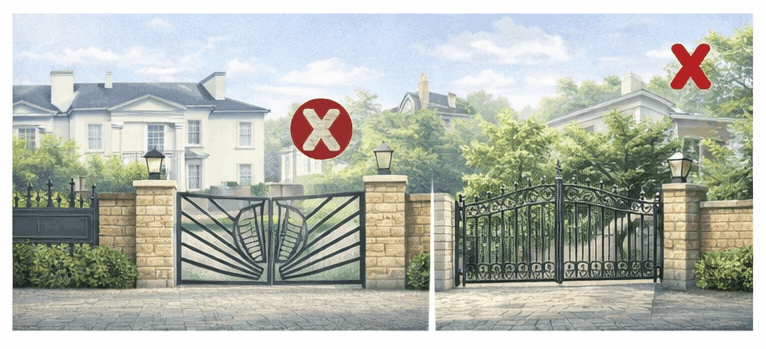
There are a few mistakes which occur quite often when people try to match gates to period properties.
The main error consists in mixing architectural periods. Victorian scroll works on a Georgian property, Georgian restraint on Victorian property and so on. There is always an urge to do things differently, however, it would be wise to stick to the original architecture.
The second common mistake concerns using too much decoration. People think that Victorian period gates should have excessive decoration while Georgian ones should be minimalistic. However, no gate would look right as both Victorian and Georgian gates were created according to strict design rules and patterns.
Ignoring scale relations leads to choosing inappropriate designs too. One cannot use the same gate design for a cottage house and for a large townhouse.
Finally, modern interpretation of some periods can be misleading too as there are many features that cannot be found in Victorian gates, for example. Therefore, one needs to study original examples of period designs before buying new gates.
Choosing the Right Design
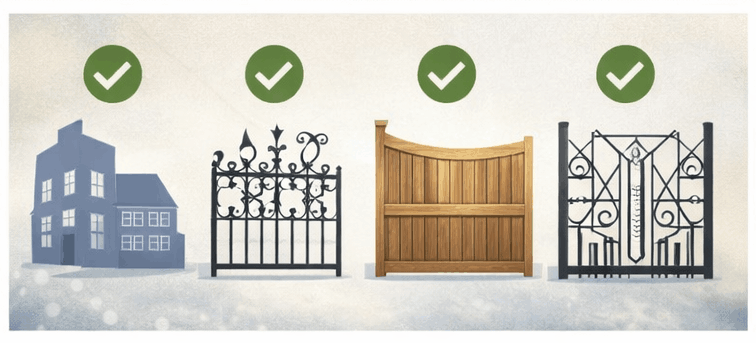
Knowing architectural periods allows choosing the right design consciously and confidently.
First of all, you need to find out the real period of the architectural property. Do not assume. Check it via documentation or architectural analysis.
Second, find original designs within your neighbourhood. Different regions have their own traditions and peculiarities in architecture.
Our collections include products specifically for different architectural periods. For example, Classic is intended for Georgian context. Manor and Balmoral work well with Victorian properties. Saxon works for Edwardian properties.