


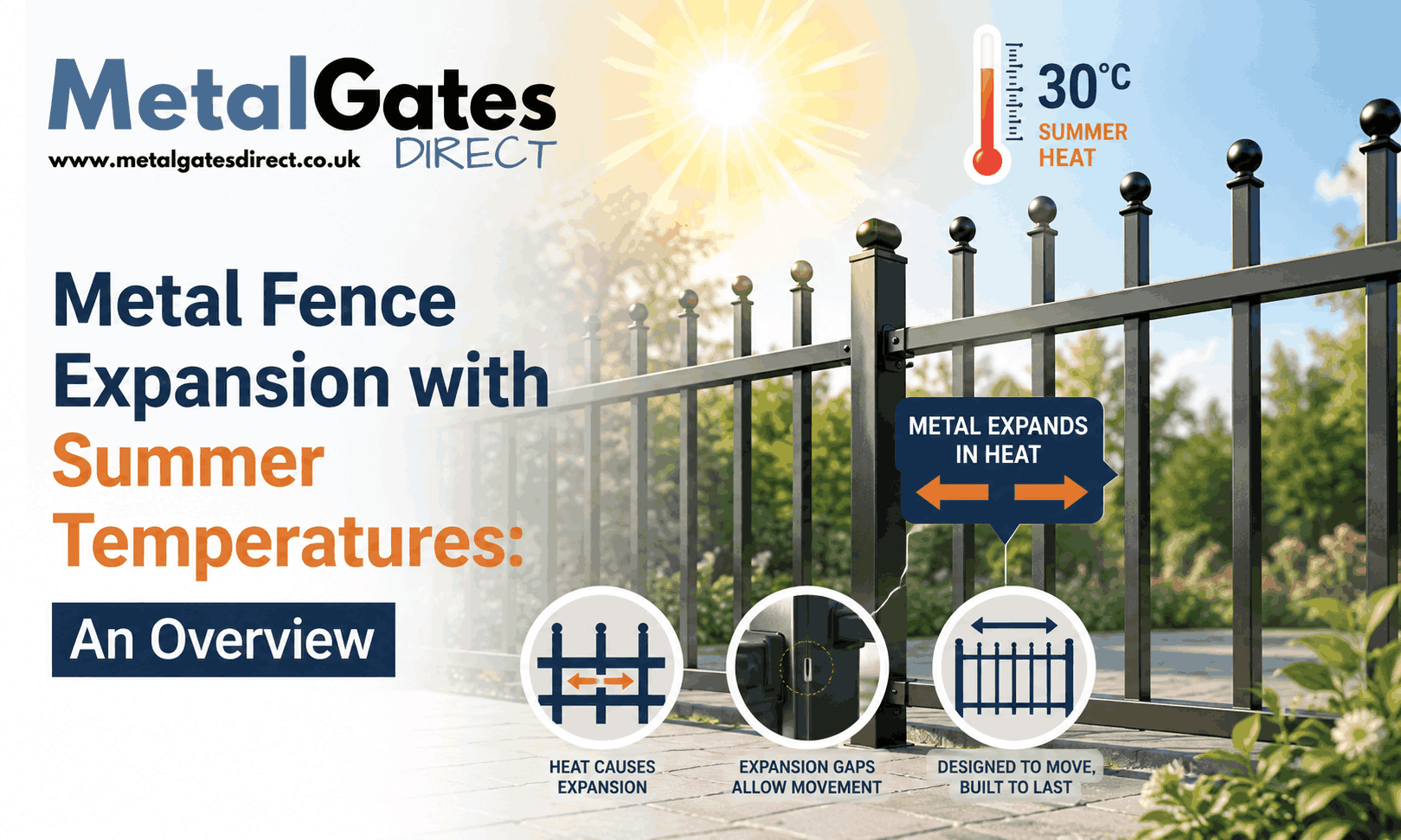
Metal fences and railings expand with temperature fluctuations – throughout the year. Nothing significant to the naked eye and not drastic in anyway. Still, metal does expand with rising summer temperatures – which is key at this time of year as we head into the summer season. Properly understanding how metal reacts with increased temperatures will prevent panic reactions when the fencing shifts.
Typical conditions allowing observing metal expansion emerge in late May. Average temperatures at early morning hours reach 10°C. Afternoon temperatures make metal surfaces reach 25°C. A change of 15 degrees occurs every day during summer. Metal expands and contracts with each temperature fluctuation, thus accumulating stresses at joints and fixing points.
As we have experienced ourselves at Metal Gates Direct, many customers ask us why their fencing "moves" in midday and why gates become jammed. This reaction comes as no surprise as the metal expands with rising temperatures, but the wrong installation prevents such occurrences.
Physics of Expanding Metals
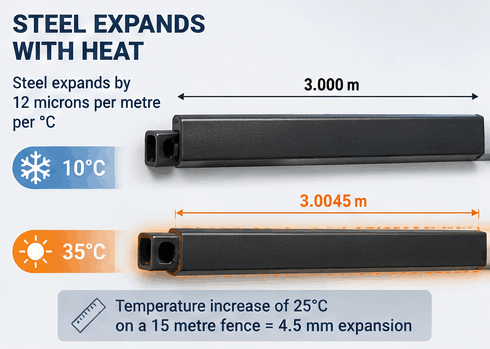
Steel expands by 12 microns per metre and per degree Celsius. Insignificant sounding, the number increases when calculating metal expansion within specific conditions. For instance, a 3-metre fencing expands 0.9 mm with a 25-degree increase of temperature. On a 15-metre fence, it means expansion of 4.5 mm.
For aluminium metal, thermal expansion is even higher: about 23 microns per metre and per degree Celsius. A three-metre long metal fence will therefore expand by 1.7 mm in case of the same change.
Expansion does not occur only in one dimension. The metal fence expands with each fluctuation, growing in length, thickness, and width. Lengthwise growth becomes especially significant when calculating expansion of metals for installing metal fences.
Paint colour influences temperature differences of metal significantly. Black colour absorbs most radiation energy, raising surface temperatures up to 50°C. Light colours reflect energy, resulting in lower surface temperatures, about 10 to 15 degrees cooler.
Symptoms of Expansion
Metal expansion with temperature fluctuations has characteristic symptoms.
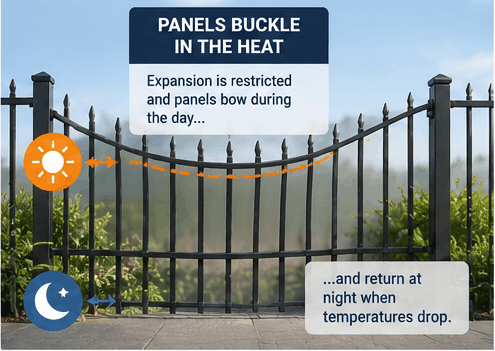
Buckling
Continuous metal panels of 3 or more metres may start buckling during midday temperatures. The metal wants to expand while the fixings prevent this process, thus making panels buckle. During nighttime, buckling disappears due to lowering temperatures.
Buckling indicates problems with expansion accommodation in a design. Though panels usually regain original shape daily, they suffer significant stress eventually.
Stress at Fixing Points
Expansion occurs at joints and fixing points where the metal tries to shift. Each temperature fluctuation exerts additional stress on fixing points.
After many heating cycles, such a metal fence will start showing the signs of fixing point problems. Screws or welding may break, while mounting holes will start expanding due to constant stresses.
Changes in Operation of Gates
Fences attached to metal fence posts undergo alignment changes. Gates work differently in the morning than during midday.
This change becomes more evident in bi-fold or other types of large gates where many panels expand or contract.
Changes in Panel Gaps
Gaps between metal panels decrease during the cold period of time while widening during warmer periods. Metal fences with enough gap accommodation will always have such space.
Without any room for accommodating metal expansion, the panels will start pushing each other. The pressure becomes too strong, leading to metal deformation and other problems.
How to Accommodate Metal Expansion
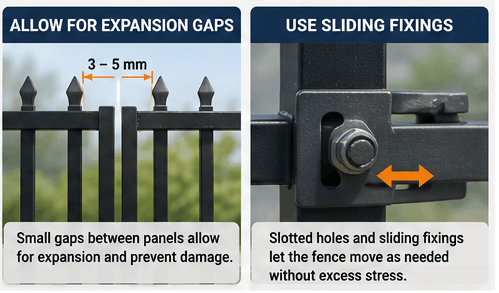
Properly installing metal expansion will help prevent further problems with the fence.
Gaps for Accommodation
The correct installation involves creating gaps between panels to allow accommodation of expansion. The recommended gaps vary between 3 mm and 5 mm. They hardly noticeable, yet necessary.
The gaps in the fence look like errors or imperfections to the owner, but the owner should understand that leaving such gaps prevents expansion and associated issues.
Sliding Fixings
There exist methods for installing fences that would allow shifting and accommodate expansion.
One such method consists of mounting holes with sliding fixation that lets the fence move without putting excessive stresses on fixings.
Metal fences with rigid fixings cannot accommodate expansions, thus facing the first failures.
Material for Fencing
Due to higher coefficients of thermal expansion, aluminium is harder to install than steel and requires better expansion accommodation. Aluminium panels will therefore need larger gaps, easier installation fixations, or shorter lengths than steel panels.
Steel is relatively forgiving with regard to thermal issues but also requires installation that accommodates expansion.
Summer-Specific Issues
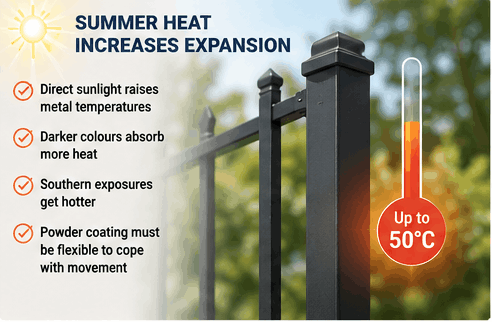
Late May till August becomes the period when thermal expansion becomes particularly significant.
Metal fences receive direct sunlight and expand more in southern locations than in northern areas.
Dark colour raises metal temperatures to maximum, so dark railings expand significantly with temperature increase.
Metal surface treatment influences how it responds to the temperature. Flexibility of powder coatings will accommodate the metal's natural properties. If applied improperly, coating cracks under thermal stresses, leading to corrosion initiation.
Thermal Expansion Causing Problems
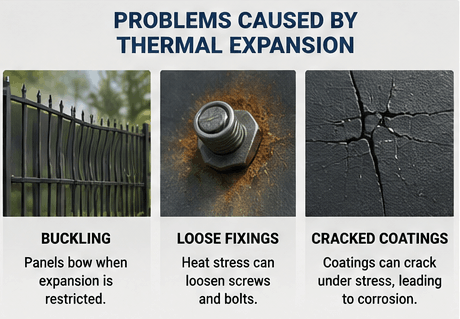
Some problems in metal fencing appear due to inadequate installation and thermal expansion.
Buckling becoming increasingly visible is one of these problems. The early detection can prevent further damage to the fencing.
Loose fixings during summertime indicate excessive stress created by thermal expansion. Reinstalling screws will only prolong inevitable problems.
Gates becoming jammed in midday and moving easily in the morning suggest misalignment caused by thermal expansion. Correcting the problem may be possible with proper adjustment of fixings.
Coating cracking occurring on the entire metal surface of the panel suggests thermal stresses of the metal. The coating could not accommodate the metal, so it cracked.
Avoiding Problems with Thermally Expanding Metals
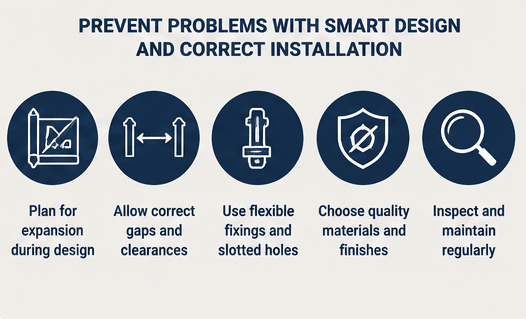
Thermal expansion of metals becomes easy to control if the installation takes this issue into account.
Our Classic, Regent, Manor, and Saxon fence lines work perfectly with thermally expanding metal as long as you respect the recommendations for installation and use correct expansion accommodations.
The problem does not consist of poor quality of the metal. The metal used for all our fences works fine. It is improper installation that leads to fencing failure despite excellent quality.
For many years at Metal Gates Direct, we have supplied metal fences across the United Kingdom. Our gates last decades since they work with metal instead of fighting it.